
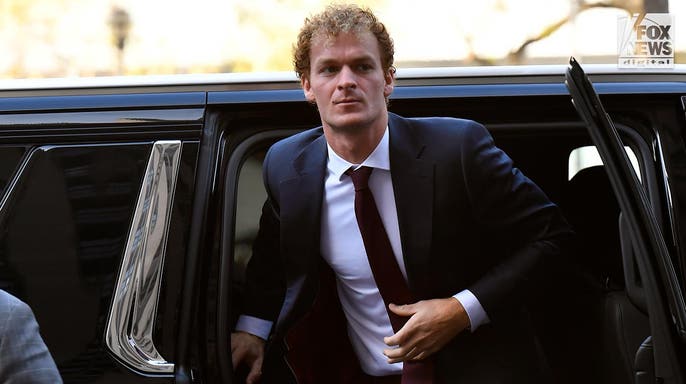
The jury in the manslaughter trial of 26-year-old Marine veteran Daniel Penny reconvened Wednesday to review three pivotal pieces of evidence central to the case. Daniel Penny faces charges of recklessly and negligently causing the death of Jordan Neely, a 30-year-old homeless man with schizophrenia, during a confrontation on a New York City subway.
Judge Maxwell Wiley the presiding judge instructed the trial dismissed the manslaughter charge against Daniel Penny on Friday after jurors reported being deadlocked.At the request of prosecutors, the case now focuses solely on the lesser charge of criminally negligent homicide, which carries a maximum sentence of up to four years. Jurors were not informed that prosecutors made this request. Penny has pleaded not guilty, according to NBC NEWS.
Judge Maxwell Wiley has discretion to impose no prison time if Penny is convicted.Judge Maxwell Wiley had previously instructed the jury that Daniel Penny could not be convicted of both charges.
“You are now free to consider Count 2. Whether that makes any difference or not, I have no idea,” the judge said in updating the jury on their task.
The killing of Jordan Neely, a Black man, by Daniel Penny, a white man, has ignited intense debate among New York City residents about race relations, public safety, and strategies for addressing homelessness and mental health.
The incident unfolded on May 1, 2023, when Jordan Neely, who was high on K2, a synthetic drug with stimulant effects, began shouting death threats at passengers, reportedly saying someone was going to “die today” and that he didn’t care about going to prison for life. Daniel Penny intervened by placing Jordan Neely in a chokehold to subdue him, an act captured on video that has since sparked national debate.

At the time of his death, Jordan Neely had an active arrest warrant and a lengthy criminal record, including a 2021 assault on a 67-year-old woman at another subway station. The trial has focused on whether Daniel Penny’s actions were justified self-defense or constituted criminal negligence leading to Neely’s death.
Daniel Penny’s New York Police Department Interrogation Video
One of the primary exhibits reviewed by jurors is a video of Daniel Penny’s post-incident police interrogation, labeled as People’s Exhibit 36A. In the voluntary police interview, Daniel Penny recounts his perception of Jordan Neely’s behavior on the subway. Daniel Penny describes Jordan Neely as:
“acting like a lunatic” and threatening passengers with statements such as, “I’m going to kill everybody. I don’t care if I go to prison for life.”
Click To Watch|Court Releases Daniel Penny’s Voluntary Police Interview as Key Evidence in Jordan Neely Chokehold Trial
Daniel Penny voluntarily explained his decision to place Jordan Neely in a chokehold, stating that Neely’s erratic behavior posed an immediate threat. Daniel Penny clarified,“I am not like trying to kill the guy, I am just trying to deescalate the situation.” He emphasized that his actions were meant to protect himself and others. Both the defense and prosecution have highlighted Daniel Penny’s calm demeanor during the interrogation and his cooperation with the police as key elements in the trial.
As the voluntary interview progress, Daniel Penny explained his decision to intervene during the subway altercation, stating:
“I am not confrontational, I am not a confrontational guy, but yet in the Marine Corps, I felt the need to step in.”
“There were women and children on the train, I am sure they will vouch for me.”
Daniel Penny did not testify during the trial, making his police interrogation the only firsthand account presented to the jury.
The Viral Vazquez Video
Jurors have also revisited People’s Exhibit 12, a video recorded by journalist Juan Alberto Vazquez. This video quickly went viral after the incident, drawing widespread public attention. It shows Daniel Penny restraining Jordan Neely in a chokehold while another passenger assists in holding Neely down.



The video captures bystanders watching the altercation, some visibly concerned. Jordan Neely is seen struggling before eventually becoming unresponsive. The length of time Penny maintained the chokehold has been a contentious issue in the trial, with the prosecution arguing that it contributed directly to Neely’s death.
Click To Watch|The man seen on video helping Daniel Penny restrain Jordan Neely on board the subway last year took the stand Tuesday on day five of witness testimony in Penny’s trial.
New York Police Department Bodycam Footage
Another critical piece of evidence is People’s Exhibit 34, The New York Police Department bodycam footage from officers who responded to the scene. The footage shows Penny calmly speaking to officers and providing an account of the incident.
Click To Watch|New Police bodycam footage released Daniel Penny restrain Jordan Neely on board the subway last year took the stand Tuesday on day five of witness testimony in Penny’s trial.
In the video, Daniel Penny explains that Jordan Neely’s threatening behavior prompted him to act. The footage also captures officers attempting CPR on Neely, who was unresponsive by the time they arrived. The bodycam video has been used by the defense to highlight Penny’s cooperation and lack of malice, while the prosecution has used it to emphasize the finality of Neely’s condition when officers arrived.
Medical Examiner Testimony
Forensic pathologist Dr. Cynthia Harris provided key testimony regarding the cause of Neely’s death. According to Dr. Harris, the chokehold applied by Penny was a significant factor in Neely’s death, which was ruled a homicide.
Watch|The trial of Daniel Penny, charged in the subway chokehold death of Jordan Neely, saw testimony from NYC Medical Examiner Dr. Cynthia Harris.
Dr. Harris testified that while Neely had preexisting conditions and a history of substance use, the chokehold directly contributed to his fatal asphyxiation. The defense raised questions about the role of these underlying conditions, but Dr. Harris stood by her conclusion that the chokehold was the proximate cause of death.


Juror Questions About Justification
The jury has sought clarification from the judge about the legal definition of “justification,” which is the cornerstone of Penny’s defense. The legal standard requires jurors to consider whether Penny reasonably believed Neely posed an imminent threat and whether the level of force used was appropriate.
The outcome of this trial hinges on the jurors’ interpretation of these key pieces of evidence and testimony. The case has garnered national attention, with debates surrounding public safety, mental health, and the limits of self-defense in public spaces. A verdict in this case could have significant implications for how similar cases are viewed and prosecuted in the future.


About The Author

Discover more from Shaneatra Jones Speaks: The Inner Thoughts of A Modern Woman
Subscribe to get the latest posts sent to your email.


